About me
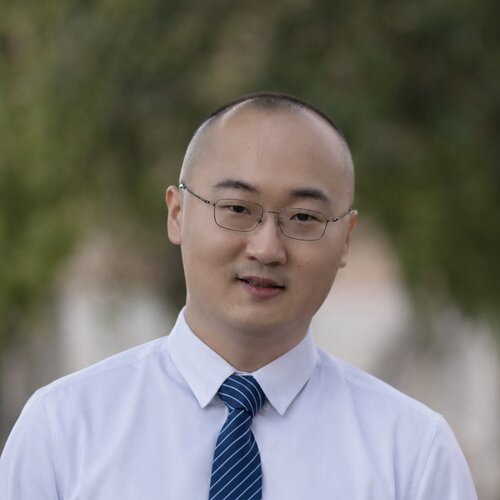
I am a postdoctoral research fellow in the Department of Aerospace Engineering & Engineering Mechanics at The University of Texas at Austin, working with Prof. John-Paul Clarke. My research focuses on smart aviation, including air transportation, air traffic control, advanced air mobility, and advanced aerial operations. I use both methods that learn from data (machine learning and AI) and methods based on models (optimization and simulations). My work cuts across disciplines, spanning aerospace engineering, data science and artificial intelligence, computer engineering, transportation engineering, industrial engineering and operations research, human factors, and geographic information systems.
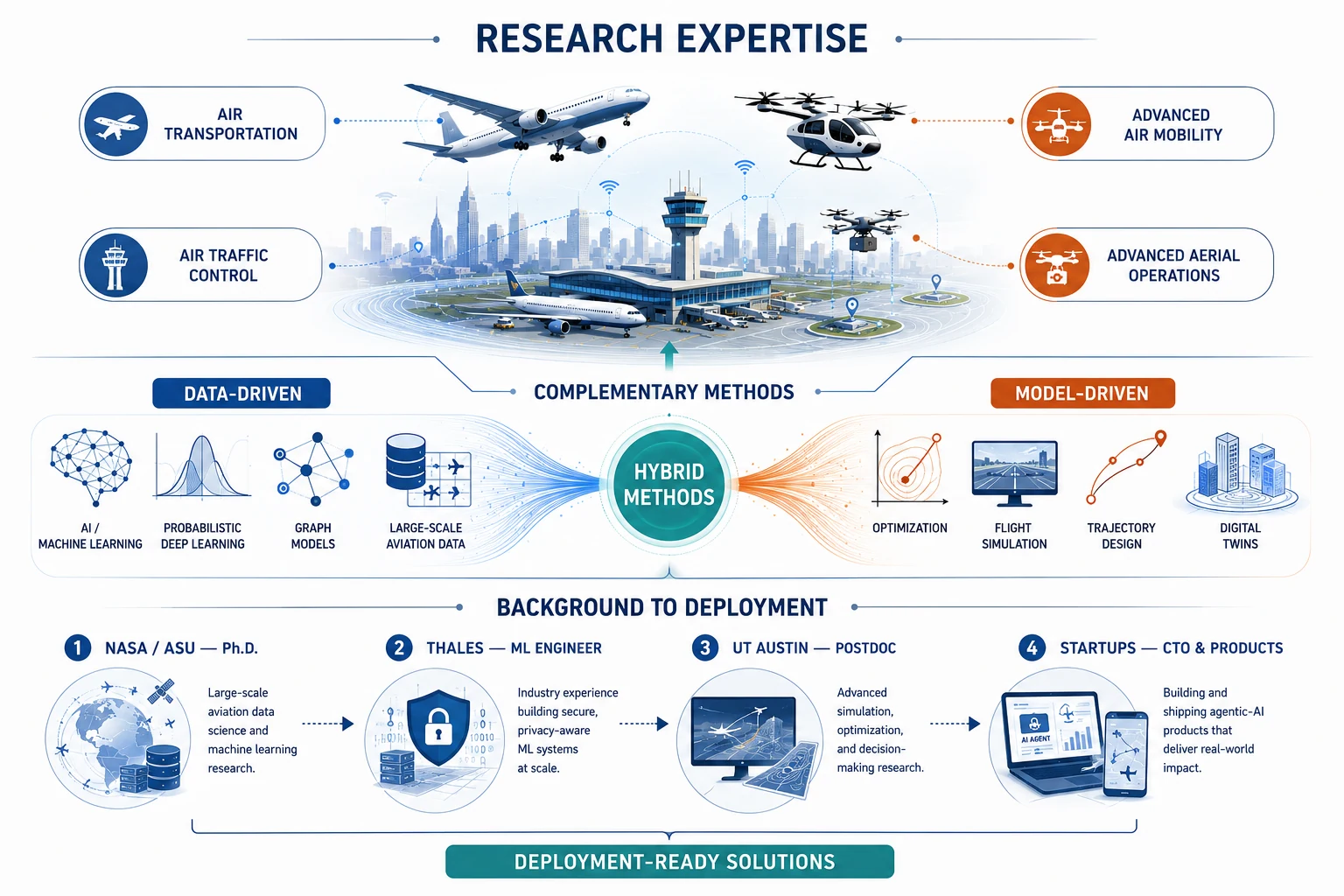
My path has crossed the spectrum from models to data in stages. My Ph.D. at Arizona State University, sponsored by a NASA aviation data science project that ran five years, was data-driven work: from probabilistic deep learning to graph models that predict air traffic behavior from operational data at massive scale. My postdoc at UT Austin has added the model-driven side, with flight simulation, trajectory optimization, and hybrid methods that couple the two traditions. Throughout, the solutions are built to be ready for deployment, rather than merely staying on paper.
Alongside academia, I have industry experience. I worked full-time at Thales Group as a machine learning engineer in San Jose, California, where I built a background in security and privacy research for critical industries. A solution I developed there, an embedding protection tool, is now part of the Thales data security platform. Moreover, experience at multiple startups (across aerospace, autonomous driving, and healthcare) has demonstrated my capacity for bold innovation and hands on execution, delivering products across different industries. Currently, I serve as co-founder and CTO of Wyzzy, an agentic-AI healthcare startup whose product is deployed in dental offices in Dallas, Texas.
I am always open to collaborations and am actively looking for research opportunities worldwide. Please reach me at yutian DOT pang AT outlook DOT com, or send me a direct message through the panel on the right edge of this page.
Research areas
- Decision-making and optimization under uncertainty — what should we do? Allocating scarce resources such as runways, airspace, and vehicle fleets, and designing schedules and trajectories, when demand, weather, and human behavior are only known probabilistically, from strategic planning down to real-time control.
- Safety, risk, and reliability of increasingly autonomous operations — how safe is it, and can we prove it? Quantifying how communication, human, and autonomy uncertainties bound the capacity and reliability of operations, combining data-driven learning with the rigor and guarantees of model-based analysis.
- Human–AI teaming in safety-critical operations — how do humans stay in command? Understanding pilot and controller communication and workload, and designing decision support that complements rather than replaces human judgment.
- Prediction of air traffic behavior under uncertainty — what will the system do? Learning how aircraft, traffic flows, and airspace demand evolve from operational data, with calibrated uncertainty attached to every prediction so it can inform real decisions.
Selected publications
- Pang, Y.*, Kendall, A., & Clarke, J. (2026). “Modeling the Impact of Communication and Human Uncertainties on Runway Capacity in Terminal Airspace.” Journal of Air Transport Management.
- Pang, Y.*, Kendall, A., & Clarke, J. (2026). “The Reliability of Remotely Piloted Aircraft System Performance under Aeronautical Communication Uncertainties.” Reliability Engineering & System Safety.
- Pang, Y.*, Kendall, A. P., Porcayo, A., Barsotti, M., Jain, A., & Clarke, J. (2026). “From Voice to Safety: Language AI Powered Pilot-ATC Communication Understanding for Airport Surface Movement Collision Risk Assessment.” Transportation Research Part C: Emerging Technologies, 184, 105540.
- Pang, Y., Zhao, P., Hu, J., & Liu, Y. (2024). “Machine Learning-Enhanced Aircraft Landing Scheduling under Uncertainties.” Transportation Research Part C: Emerging Technologies, 158, 104444.
- Pang, Y., Hu, J., Lieber, C., Cooke, N., & Liu, Y. (2023). “Air Traffic Controller Cognitive Workload Level Prediction using Conformal Dynamical Graph Learning.” Advanced Engineering Informatics, 57, 102113.
- Pang, Y., Zhao, X., Hu, J., Yan, H., & Liu, Y. (2022). “Bayesian Spatio-Temporal Graph Transformer Network (B-STAR) for Multi-Aircraft Trajectory Prediction.” Knowledge-Based Systems, 249, 108998.
- Pang, Y., Zhao, X., Yan, H., & Liu, Y. (2021). “Data-driven trajectory prediction with weather uncertainties: A Bayesian deep learning approach.” Transportation Research Part C: Emerging Technologies, 130, 103326.
- Pang, Y., Cheng, S., Hu, J., & Liu, Y. (2021). “Evaluating the Robustness of Bayesian Neural Networks Against Different Types of Attacks.” CVPR 2021 Workshop on Adversarial Machine Learning in Real-World Computer Vision Systems.
News
- Sep 2026 — The three stage program toward TRACON arrival automation is complete, with all three manuscripts now on arXiv. Trajectory-Based Optimization for Air Traffic Control in the Terminal Maneuvering Area (arXiv) sets up the lateral formulation of arrival trajectory design, turning radar vectoring into computable path extensions and speed profiles, and is under review at Transportation Research Part C. Optimal TRACON Descent Procedures under Wind Uncertainty and Fuel Savings Factors (arXiv) goes down to the aircraft configuration level, with six degree of freedom simulations of the airframe coupled to its flight management system, and selects the flap deployment speeds and glideslope capture distance that minimize expected fuel under wind uncertainty subject to a stabilized approach guarantee; it is under review at the AIAA Journal of Aircraft. Trajectory-Based Co-Optimization of Arrival Scheduling and Descent Path Design in the Terminal Maneuvering Area (arXiv) closes the loop by co-optimizing the lateral and vertical procedures in a single scheduler, evaluated on Atlanta arrival scenarios against current published procedures; it is under review at Aerospace Science and Technology.
- Aug 2026 — NASA ACERO wildfire air traffic management: a technical review of firefighting UAVs for wildland fire — platforms and missions, flight dynamics and control models, and the coupling of fire-propagation models to UAV planning — and a companion review of optimization formulations for the firefighting-UAV problem — constraints, cost functions, and tractability across the strategic, tactical, and trajectory layers.
- Jun 2026 — Data-Driven Runway and Taxiway Exits Prediction of Landing Aircraft: A Case Study at Hartsfield-Jackson Atlanta International Airport published in the Journal of Air Transport Management.
- May 2026 — Modeling the Impact of Communication and Human Uncertainties on Runway Capacity in Terminal Airspace published in the Journal of Air Transport Management.
- Mar 2026 — The Reliability of Remotely Piloted Aircraft System Performance under Aeronautical Communication Uncertainties published in Reliability Engineering & System Safety.
- Jan 2026 — From Voice to Safety: Language AI Powered Pilot-ATC Communication Understanding for Airport Surface Movement Collision Risk Assessment published in Transportation Research Part C: Emerging Technologies.
- Oct 2025 — Invited talk at the INFORMS Annual Meeting, Atlanta.
- Mar 2025 — 2nd place in the FAA Machine Learning / AI Data Challenge for Aviation Safety.
- Jul 2024 — Joined UT Austin as a postdoctoral research fellow.
- May 2023 — Ph.D. from Arizona State University; Outstanding Graduate Research Award, ASU MAE.
Visitors
Visit log (site owner only)